
Lately, it feels as though there is a new security issue to deal with every day. One day it is a PHP update. The next, a newly discovered weakness in NGINX.
As MyWork’s CTO, I work through what those alerts mean for our hosting environments, coordinate with providers and handle server updates where they fall to us. A website can look normal while that work is happening behind the scenes.
With 2026 drawing to a close, I wanted to explain what I’m seeing, what the year’s incidents mean for business owners, and why having an experienced team looking after your website is worth considering when you compare providers.
Reviewed on 20/11/2026. This article covers selected incidents and the latest available reporting.
Are cyber security incidents increasing?
The Australian Signals Directorate’s Australian Cyber Security Centre responded to more than 1,500 cyber security incidents in the 2025–26 financial year, up 20% on the previous year. Its annual report also describes how AI is making it easier to identify weaknesses and carry out attacks at scale. Read the ACSC’s annual threat report.
The privacy regulator’s figures add some context. The OAIC received 667 data breach notifications in January–June 2026, compared with 662 in the previous six months. The total changed only slightly, while several categories of larger breaches increased. See the OAIC’s latest breach statistics.
When I look at these figures, I think about both the frequency of incidents and the amount of information exposed. For your business, that means understanding which accounts, suppliers and systems hold your customer data, and who is responsible for protecting them.
What has happened during 2026?
Customer data exposed through major businesses and suppliers
Origin Energy confirmed unauthorised access to customer information in July. Its later review identified approximately 900,000 affected current and former customers. Read the ABC’s August report on the Origin breach.
Quest Apartment Hotels identified an incident in August involving unauthorised access through a third-party technology provider. Its October update confirmed that information relating to approximately 1.99 million customers was affected. The types of information involved varied between individuals. Read Quest’s customer update.
Coles announced a cyber security investigation on 16 November. At that stage, it reported that its investigation had found no evidence of customer, team or supplier data being compromised or removed. That distinction is important when an incident is still being assessed. Read Coles’ 16 November statement.
These are the questions I would encourage smaller businesses to ask too. What customer information do you collect? Where is it stored? Which suppliers can access it, and who checks the security of those systems?
The Microsoft email outage disrupted an ordinary working day
The Microsoft 365 outage that affected Australian businesses on 13 November interrupted Outlook and services connected to Exchange Online. Microsoft subsequently reported recovery across its products. It said it had no indication of malicious activity behind the incident. Read Reuters’ report on the recovery.
Our team at MyWork also lost access to Outlook.com and used our website service notice to help customers find another way to reach us. It showed how quickly an email problem can affect approvals, enquiries and everyday work.
For me, the first task is understanding what has happened. An outage calls for ways to keep working and communicating. A data breach requires investigation into access to information. A software vulnerability needs an exposure assessment and an appropriate fix. That assessment shapes the response.
WordPress security extends beyond the website dashboard
WordPress sites combine the main WordPress software with plugins, a theme and the hosting software underneath. Each has its own maintenance requirements.
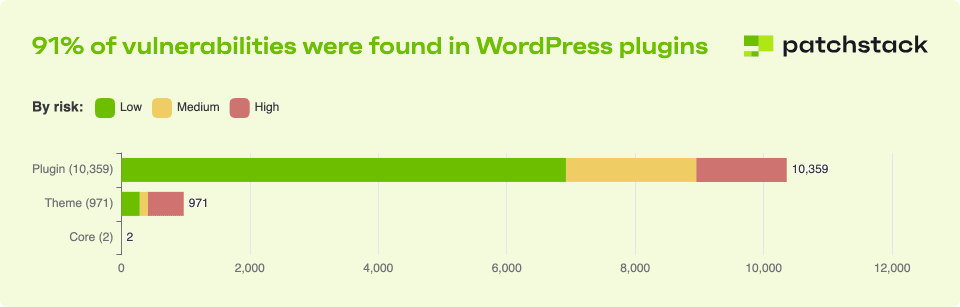
Patchstack’s State of WordPress Security in 2026 report recorded 11,334 new vulnerabilities during 2025, up 42% on 2024. It attributed 91% to plugins and 9% to themes. Those figures describe vulnerabilities discovered in the preceding year. They help explain the maintenance workload that businesses brought into 2026. Read Patchstack’s report.
WordPress has continued to release security updates throughout 2026. Keeping up with those releases is part of looking after a site as new weaknesses are identified and fixed. In July, the ACSC also warned of an active campaign exploiting weaknesses in website content management systems globally, including Australia. Follow WordPress security announcements and read the ACSC’s CMS alert.
PHP security updates in October and November
PHP is the software that runs WordPress on the server. In October, the PHP project released fixes for two critical weaknesses that could allow attackers to run code remotely. Another set of security releases followed on 19 November. The risk depends on the version and configuration in use. See PHP’s official security announcements.
When a PHP advisory comes through, I need to consider the hosting environment and compatibility with the website. Our October PHP security update explains why this work needs attention even when a site appears to be running normally.
The latest NGINX vulnerabilities
NGINX is web server software that helps deliver websites to visitors. On 18 November, researchers disclosed five flaws under the name NGINX2Root. CERT-EU advised prompt updates because affected configurations could allow an attacker to execute code remotely. Its advisory said exploitation had been demonstrated by researchers, with no exploitation in the wild reported at publication. Read CERT-EU’s NGINX advisory.
To decide what action is required, I need to check the software version, enabled features and hosting setup against the vendor’s security advisories and arrange the applicable updates.
Is AI making the problem worse?
AI is changing the pace on both sides. The ACSC says attackers can use it to find vulnerabilities, develop exploits and carry out more convincing impersonation attempts. Security teams can also use AI to find weaknesses and respond faster. Read the ACSC’s assessment.
The NGINX2Root researchers specifically describe AI-assisted vulnerability discovery as part of this changing environment. Read their research summary.
I see value in tools that help researchers find weaknesses earlier. Each discovery also creates work for the people responsible for the affected systems. Someone still needs to decide whether it affects your website, how urgently to act and whether the fix has been applied successfully.
How I’m handling these updates at MyWork
The latest PHP and NGINX advisories are examples of the work I’m handling alongside our hosting partner. The responsibility depends on where a website is hosted.
- For our WP Engine-hosted sites, I coordinate with WP Engine, which handles the relevant platform updates.
- For our managed AWS instances, I’m handling the applicable server updates directly.
- For sites hosted elsewhere, the hosting provider needs to confirm exposure and the server updates required.
I also look at the responsibilities around the website itself. Plugins, themes, user access, custom code and backups each need attention according to the services your provider manages. Clear ownership helps us work out who needs to act.
Why it can be worth paying more for ongoing support
If you are comparing website costs, my advice is to ask who will assess an urgent security advisory, arrange the fix and check the result. That responsibility has value throughout the life of the site.
Much of my work involves understanding which systems are affected, deciding how urgently to act, coordinating with suppliers and checking compatibility. Our wider team helps keep customers informed. During an outage, that communication can help people make decisions about their working day.
That is one reason I value bringing hosting and technical support together. Someone who understands the website and its hosting setup can make decisions with the whole system in view.
What I recommend checking before the end of the year
- Confirm ownership. Know who manages your hosting software, WordPress, plugins, backups and email.
- Check update arrangements. Ask how urgent patches are handled and what happens when software stops receiving security updates.
- Review access and recovery. Use multi-factor authentication, remove access people no longer need and confirm how backups would be restored.
- Keep another contact method available. Make sure customers and staff can reach the business if email is unavailable.
These are the checks I would prioritise. They also align with the ACSC’s advice on software updates, account protection and backups. Read its practical guide for business leaders.
Frequently asked questions
Does a security advisory mean my website has been hacked?
An advisory identifies a weakness. Your provider needs to check whether your versions and configuration are affected, apply the appropriate fix and investigate further if there are signs of compromise.
Does updating WordPress also update PHP and NGINX?
PHP and NGINX are managed in the hosting environment. Ask your provider to confirm responsibility for those updates alongside WordPress, plugins and themes.
What should I do if my website is hosted outside MyWork?
Ask your host to assess the latest PHP and NGINX advisories and confirm the applicable fixes. MyWork can help review your website and discuss bringing hosting and support together.
How can I request help from MyWork?
MyWork COMPLETE customers can contact our helpdesk. We can confirm the scope and any available support credits needed for additional work. For a specific WordPress issue, you can request one-off support.
Make sure someone has responsibility for your website
If you use MyWork COMPLETE, contact our helpdesk with any questions about your setup. We can confirm what is covered and whether additional work would use your available support credits.
If you need help with a particular issue, start with a WordPress support ticket. If you would like ongoing help looking after the site, talk to MyWork about hosting and support. We will help you work out who is managing each part of your website and where it needs attention.